


Presented by PivoHub and Étiquette PDF
Why launch another oat milk brand in a category already dominated by major players?
For Varty All Natural, it started with a simple problem: the founders couldn’t find the product they were looking for.
Made in Canada with Canadian organic oats and a short ingredient list, Varty is building its position around three things: the product, the design and a local supply chain.
Launched about six months ago after nearly two years of development, the Montreal-based brand is already rolling out to nearly 100 stores across Quebec, including Avril, independent IGAs, Metro and Adonis.
But the next challenge is bigger: turning rapid Québec traction into a national distribution strategy.
At CHFA NOW Toronto, we spoke with Lina Greiche of Varty All Natural about product development, manufacturing partnerships, Canadian oat sourcing, packaging design, retail distribution, and what comes next for the brand.
🎧 Listen to the full Beverage + Terroir interview.
________________
Varty All Natural: Oat Milk as the First Chapter
Launching a new oat milk brand in a category already occupied by major players may seem ambitious. For Varty All Natural, however, the starting point was not a complicated market analysis. It was a simple problem: the founders could not find the product they wanted on grocery store shelves.
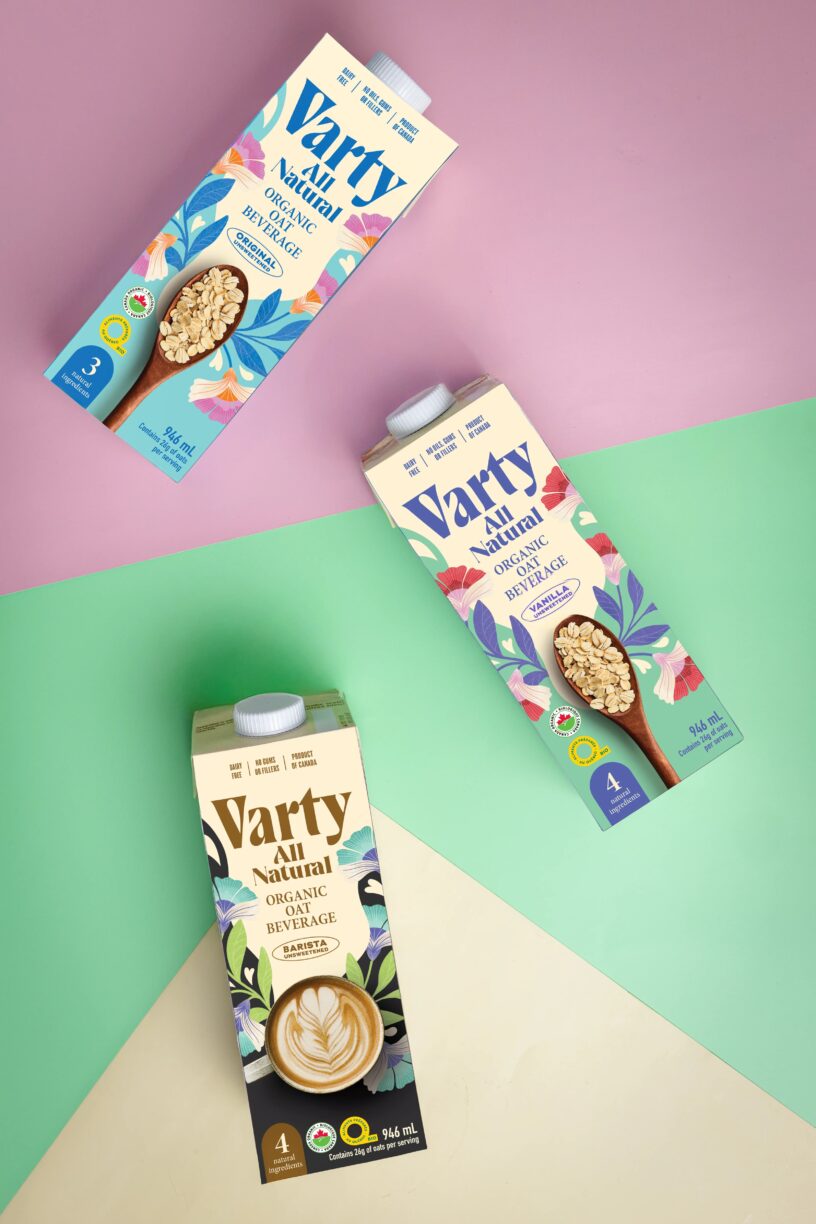
Organic, made in Canada, with a short ingredient list and a local positioning — that gap in the market led Lina Grach and her business partner Tony to develop their own product.
Today, roughly six months after launch, Varty All Natural says it is already present in nearly 100 stores across Quebec. The company works with manufacturing partners and sources Canadian oats for its products.
But beyond oat milk itself, the launch strategy is what makes the story interesting.
Differentiation in a Mature Category
In a category with established brands and familiar packaging codes, Varty is not simply trying to reproduce what is already there.
Its packaging takes a more illustrative and distinctive approach, developed with a young Quebec designer.
The package therefore becomes part of the differentiation strategy — and an important first point of contact with the consumer.
The second is the product itself.
Varty currently offers three SKUs: Original, Vanilla and Barista. According to Lina Grach, in-store sampling has generated a strong consumer response, with all three products performing well enough that the company does not currently rely on a single “hero SKU.”
That matters in a category where consumers may already have a brand they routinely buy.
The Next Market Is Canada
A presence in nearly 100 stores is an important first step. The next challenge is turning that Quebec traction into a broader Canadian distribution strategy.
That is one of the reasons Varty All Natural came to CHFA NOW Toronto.
For a young Quebec food company, Toronto is more than a trade show floor. It is a meeting point with the national ecosystem: retailers, distributors, buyers and potential partners.
The company says it built its operations from the beginning with scale in mind. Working with manufacturing partners allows Varty to expand without immediately having to invest in a complete production facility.
But national growth brings another set of challenges: forecasting, production capacity, logistics, replenishment, distribution and managing different markets.
Sourcing as Part of the Proposition
At a time when supply chains have become both an operational and commercial issue, using Canadian oats also gives Varty a clear sourcing story.
The company says it monitors ingredient costs and works closely with its supplier to manage price fluctuations.
It may not be the most visible part of the brand story, but for a growing food company, these fundamentals — availability, cost, capacity and supply continuity — can ultimately determine how far a product can scale.
More Than Oat Milk
Grach describes oat milk as the first chapter for Varty All Natural. The company is already considering new formats, additional SKUs and other plant-based beverages.
That may be the bigger story.
Varty is not simply building a brand around one product. It is attempting to create a platform that can support a broader beverage portfolio.
The Canadian plant-based beverage market already offers consumers plenty of choice. For a new brand, the challenge is therefore not simply creating a good product. It is creating enough reasons for consumers to notice it, try it, buy it again — and ultimately find it in more stores.
At CHFA NOW, Varty All Natural arrives with an early proof point in Quebec. The next question is whether that proposition can travel.
_______________________
New Content and Strategic Partnership
In partnership with PivoHub, Baron Mag has launched a series of interviews and articles highlighting their partners and the food industry landscape in Québec and Ontario. This series will showcase emerging food entrepreneurs and provide insights into the latest trends and best practices within the sector.
Objective: To better understand the food industry and provide data-driven insights to help businesses improve performance and efficiency.
Partnership with PivoHub
The series will also demonstrate how PivoHub can support your business through its order management and data tools, helping companies optimize operations and gain actionable insights.
Interested?
To discover PivoHub or to promote your food business, contact: [email protected]
For demos and more information: [email protected] or visit PivoHub.
______
About Beverage + Terroir
As the beverage and beer industries evolve, so too does the media that covers them. For several years, we’ve been reporting on the industry outside of Quebec in English through our Baron Mag and BBQ (Business of Beer of Quebec) podcasts.
With Beverage + Terroir, we’ve expanded our coverage to encompass beer, beverages, and food, providing a comprehensive look at the entire industry and its complex interconnections. The podcast explores not only trends, innovations, and market shifts, but also the people, places, and processes that define the craft, commercial, and artisanal sectors across Canada, the USA, and beyond.
Beverage + Terroir aims to give listeners a deeper understanding of how local ingredients, regional terroir, and industry dynamics shape the drinks we enjoy — from pint to plate.