

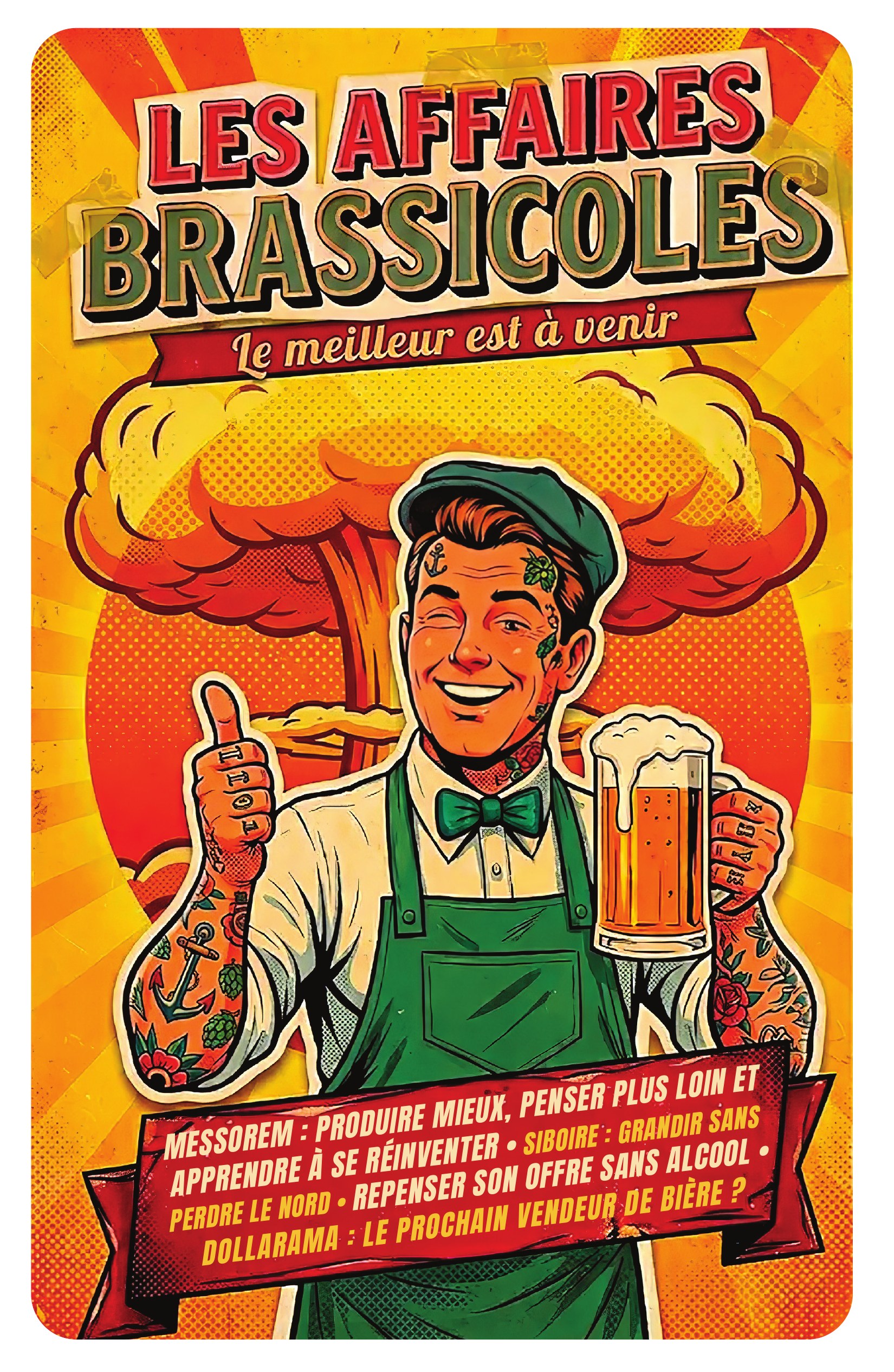
The 16th edition of the AMBQ Convention felt like a fresh start for the Quebec brewing industry. After several years marked by negative headlines, closures, and economic uncertainty, a more constructive vision was beginning to emerge. Not a return to easy growth, but a growing determination within the industry to rethink its ways of doing business and build more resilient companies.
The conversation is evolving. More and more brewers are seeking to better structure their businesses, adopt new technologies, and manage their operations with greater strategic rigor. The focus is shifting toward more controlled production, a genuine understanding of consumers rather than assumptions about what they want, and decisions based on actual market behavior.
There is also a growing recognition that it is possible to pool resources, share expertise, and approach costs differently. Collaboration could evolve from a “nice-to-have” to a business necessity.
Data is another key element of this shift. It is no longer enough to talk in theoretical terms about the value of sales data or consumer insights. Brewers need to know what information is available, how to interpret it, and, above all, how to put it to practical use. Which products are driving sales? Which accounts are worth developing? Where are we losing margin? What do customers actually keep buying? These are the questions that transform information into better business decisions.
The industry must also continue to address major structural challenges: distribution, business succession, entrepreneurship, sales development, and changing attitudes toward alcohol. These issues will directly determine which breweries will succeed in adapting and remaining viable over the next decade.
The conference itself seemed calmer and slower-paced than in previous years. The energy may have been more subdued, but the organizers deserve credit for holding the event and bringing the industry together at a critical moment.
A New President, a New Chapter for the AMBQ?
The appointment of Christophe Limoges as president of the AMBQ raises an important question about the association’s next chapter: what will its priorities be, and where will it focus its efforts?
I’ve been asked several times what this leadership change might mean for the industry. Will the AMBQ maintain its strong focus on political advocacy and government relations, as it did under the previous presidency? Or will the new leadership bring a more practical, business-focused approach, returning to some of the fundamentals that breweries need most?
There is certainly no shortage of challenges.
Distribution remains a major concern. Breweries need help developing their sales channels, building relationships with buyers, and reaching more consumers. Sales and marketing support, access to relevant market data, business development, and succession planning are all becoming increasingly important.
There is also an opportunity to strengthen public education: helping consumers understand Quebec beer, its diversity, its economic contribution, and the people who make it. Better communication about brewing culture and responsible drinking should continue to be part of this effort.
Political representation will, of course, remain important. Regulation, taxation, government policies, and market access have a direct impact on breweries’ ability to operate and grow. Advocacy and concrete support for businesses are not mutually exclusive; they should reinforce one another.
The real question is how the association will balance these responsibilities and translate its mandate into tangible value for its members.
Christophe Limoges is taking the helm at a time when the industry is reevaluating its business models and seeking a more sustainable path. Expectations are high, and the coming months should provide greater clarity on the priorities he intends to set.
A new presidency is an opportunity to ask not only what the AMBQ should stand for, but also what it should help breweries achieve. We contacted him for an interview.
Business Succession
Business succession deserves a much more prominent place in industry discussions. Many independent breweries are reaching a point where the founders are considering retirement, a transfer of ownership, or a sale. Yet succession planning is rarely discussed openly—or early enough. This issue has been raised with me several times this year and at the conference.
Who takes over when a founder wants to step down? How do you value a brewery whose identity is so closely tied to its founder? What financing options are available to the next generation? And how can an independent business preserve its culture, its employees, and its place in the community during a change of ownership?
Several avenues are possible: family succession, management buyouts, employee ownership, partnerships, mergers, or acquisition by other brewing or agri-food groups. Each comes with its own financial, legal, and operational challenges.
The AMBQ could play a valuable role by helping its members understand these options, connecting owners with the right professionals, and creating opportunities for knowledge transfer between generations of entrepreneurs.
This is not simply about preparing businesses to be sold. It is about ensuring that viable breweries have a future beyond their founders. An industry cannot focus solely on creating the next generation of breweries; it must also consider how to transfer, preserve, and sustain those that already exist.
AI: From Writing Assistant to Business Tool
AI is everywhere, but its practical use in the brewing industry and among suppliers remains surprisingly limited—or perhaps companies, for various reasons, simply aren’t disclosing how they use it. Aside from companies like Pivohub, which helps businesses make better use of their data, many companies still seem to associate AI primarily with drafting emails, refining communications, or creating marketing content.
The potential is much greater.
AI could help breweries and suppliers forecast demand, analyze sales trends, optimize production schedules, manage inventory, improve purchasing decisions, identify profitable customers, and better understand consumer behavior. It could also support quality control, maintenance planning, and administrative tasks.
The challenge isn’t adopting AI just to appear innovative. Rather, it’s about understanding where the technology can solve real business problems, save time, reduce costs, or generate additional revenue.
We must also address data quality, privacy, training, and the practical skills needed to use these tools effectively. Without reliable data or a clear business objective, AI is unlikely to deliver meaningful results.
The industry needs more concrete examples from companies that are already using AI: which tools they’re using, to solve which problems, at what cost, and—most importantly—with what results. The next step is to move beyond AI as a writing assistant and begin exploring it as a true business tool.
Data: What a Year of Sales Can Teach Us
The conference What a Year of Sales Teaches Us with Pivohub was one of the standout sessions at CA2026, held before a packed house. Pivohub presented a practical look at what a full year of sales data can reveal about a brewery—from product performance and customer behavior to sales trends and opportunities that might otherwise go unnoticed.
A reminder that data is only valuable if you know how to use it. Understanding the numbers, identifying trends, and turning these insights into day-to-day decisions can have a real impact on product portfolio management, distribution strategies, production planning, and sales development.
In fact, there’s easily enough material for a two-hour session on data literacy alone. Brewers need more than just dashboards and reports; they must know how to interpret their numbers, ask the right questions, and turn that information into concrete business decisions.
The packed room shows that this is not just a passing interest. It is a real need across the entire industry.
From Market Reports to Local Insights
NielsenIQ’s current-year Market Analysis and Trends conference offered a useful window into the market as a whole. This report helps companies understand category shifts, new consumer habits, and emerging trends. But national or provincial figures don’t necessarily tell a brewery what’s happening in its own backyard.
A brewery in the Gaspé Peninsula, for example, needs more than just a general overview of beer sales in Quebec. It needs to know which styles are performing well in its region, which formats are gaining ground, what prices consumers are willing to pay, and which products are losing momentum. It also needs to understand why certain products succeed in one market and fail in another.
Are fruit-flavored beers gaining popularity? Are smaller formats performing better than traditional cans? Are consumers buying more locally, or are price and convenience driving their choices? Which new bars, restaurants, retailers, or tourism businesses could become promising accounts? Where are the opportunities that competitors haven’t yet identified?
This is the kind of information that can guide a decision next week—not just feed into a strategic plan once a year.
The industry needs to move from market data to market intelligence. This means combining broad trends with regional sales figures, knowledge of local consumers, in-store observations, and information on new businesses. It also means helping breweries understand what works, what doesn’t, and why.
The AMBQ could play a useful role by developing more regional intelligence and making it accessible to its members. In a challenging market, breweries don’t need more reports. They need actionable information: where to sell, what to produce, which formats to prioritize, and where the next opportunity lies.
Understanding the big picture is important. Knowing what’s happening in your own market is what enables you to make the next business decision.
Young Consumers, Location, and the Limitations of Market Data
Attracting young consumers remains one of the brewing industry’s biggest challenges. But what really captures their attention? Colorful packaging, fruity beers, and new flavors? Or is the real answer much more practical: being in the right place at the right time with a product that’s easy to find?
Bright colors and a contemporary brand image can help a beer stand out, especially among consumers less familiar with craft beer. Safe, fruity beers can also offer an accessible entry point for young adults accustomed to the flavors and formats of ready-to-drink beverages. Having these products in its portfolio could broaden a brewery’s appeal and introduce new consumers to beer. But this remains a hypothesis to be tested, not a guaranteed path to long-term loyalty.
Location matters just as much as the product. A well-designed can cannot compensate for poor distribution or limited visibility. Shelf placement, high-traffic locations, availability in convenience stores, and strong retail partnerships significantly influence whether consumers try a product and repurchase it. For breweries, the question isn’t just what to sell, but where consumers are most likely to discover it.
There is also a structural challenge. The Quebec beer market is highly fragmented: numerous independent companies are competing for limited shelf space, distribution channels, and consumer attention. Breweries often lack the resources on their own to invest in marketing, market research, and sales infrastructure that would allow them to compete more effectively. Could greater collaboration, shared resources, or more coordinated market development help independent breweries reach consumers more effectively?
A Standout!
One of the most interesting initiatives at CA2026 was “New Products, Ideas, and Solutions—Lightning Talks,” hosted by Caroline Leclerc. The concept was simple: AMBQ exhibitors took the mic for a 15-minute pitch to introduce their company, explain their offerings, and propose relevant solutions for brewers.
Fast-paced and dynamic, the format gave participants a useful overview of the suppliers and partners present at the show. Rather than relying on conversations at each booth, brewers could quickly see who was there, what each company does, and where to find potential solutions.
It was also a great way to give exhibitors visibility and showcase their expertise to people who might not have stopped by their booths otherwise.
There’s room to take this further. Why not turn it into a two-day program, with sessions dedicated to the different aspects of brewery operations: ingredients and production, packaging and equipment, sales and distribution, technology, financing, and business services?
Fifteen minutes is enough to introduce a company and identify a problem it can solve. A longer program would give brewers a more comprehensive picture of the resources available to them, while offering partners a structured way to demonstrate their value.
In an industry where time and resources are limited, this is a practical way to connect breweries with the people and solutions that can help them move forward. I’d like to see more of this at the next edition.
News and Rumors
Noctem is set to launch Radiance Célébration Brassicole, a new event scheduled for April that aims to bring together the B2B and B2C sides of the brewing industry. This is a concept to watch: a space where brewers can meet buyers, showcase their products, build relationships, and, most importantly, sell directly to consumers. [Écoutez notre entrevue]
Rumors are also circulating that Montreal is preparing its own B2B/B2C beer event. Nothing has been confirmed yet, but we’ll keep our readers informed.
It’s an interesting time. Aside from Oktoberfests—a completely different proposition, with their own cultural and commercial momentum—beer festivals are operating in a challenging environment. Traditional formats are struggling to maintain their appeal, while consumer expectations, spending habits, and the broader beverage market continue to evolve.
The industry must rethink what a beer event is supposed to offer. Entertainment and discovery remain essential, but they may no longer be enough on their own. A new generation of consumers needs reasons to attend, and breweries need a clearer return on the time, staff, and money they invest in participating.
This is where the B2B/B2C model really comes into its own. Bringing consumers and industry professionals together in a single space allows the event to go beyond simple tastings. Brewers can showcase their portfolio, meet potential retail and restaurant partners, develop accounts, and generate sales, while consumers gain direct access to the people and stories behind the products.
It also gives breweries a better reason to continue participating. Representation is part of the business, but it must lead somewhere: new relationships, distribution opportunities, customer loyalty, and revenue.
Radiance could represent an interesting step toward a festival model more grounded in commercial reality—a model that recognizes that the future of beer events may lie in bringing the industry and its market together, rather than treating them as two separate audiences.
The question is no longer simply how to attract people to a beer festival. It’s how to make the event interesting enough for consumers and profitable enough for the breweries that pay to be there.
What’s Missing from the Conversation
Several topics need to be addressed more openly at the upcoming Congress. Beyond the format of festivals and the need to attract new consumers, breweries face structural challenges that deserve a much more prominent place in industry discussions.
Distribution remains one of the industry’s biggest concerns, yet it was notably absent from the program. Market access, distribution partnerships, and finding new ways to reach consumers have become increasingly important. This year has been a time of reevaluation for many breweries, which are seeking new partners, new distribution models, and, in some cases, completely different ways to bring their products to market.
Data and sales intelligence are another missing piece. Breweries need to understand what actually drives sales: which products are performing well, where they’re selling, who’s buying them, how often customers return, and which channels generate the best margins. Better access to relevant data helps companies make more informed decisions regarding production, pricing, distribution, and portfolio management.
And then there’s sales. It seems obvious, but sales development remains one of the most important skills a brewery can build. How should they approach buyers? How do you maintain relationships with retailers? How do you turn an initial order into a recurring account? How do you promote your products in an increasingly crowded beverage market? These are practical questions that deserve practical answers.
Business succession (repreneurship), as we mentioned, was another major omission from the program. Many independent breweries are approaching a major generational and ownership transition: founders are considering retirement, businesses are facing valuation and transfer issues, and successors aren’t always in place.
Health and changing consumption habits should also be part of the discussion. Moderation, non-alcoholic options, wellness, and shifting attitudes toward alcohol are transforming the market. These are not passing fads that can be addressed with a single new product. They reflect a broader shift in how people choose to drink, and breweries need to understand what this means for their future portfolios and business models.
Finally, the festivals themselves deserve a more candid conversation. What is no longer working? Where should these events be headed? And above all, what do breweries really need? There is no one-size-fits-all festival model. The needs of a Montreal brewery aren’t necessarily the same as those of a regional producer. Local markets, tourism, distribution networks, consumer profiles, production capacity, and operating budgets all influence what makes an event profitable. Please, enough with the autopilot!
See you next year—and keep following our coverage of other trade shows. Once again, congratulations to the AMBQ team! Questions or comments? Email me at [email protected].