


x INNOMALT
Launching a new craft brewery in Quebec no longer means what it did 10 or 15 years ago.
Back then, opening a brewery could seem like a natural way to participate in the rapid growth of the craft beer market. Today, the environment is very different. Costs have increased, distribution has become more complicated, retail shelves are crowded, and established breweries are themselves being forced to rethink their business models.
And yet, new breweries continue to open.
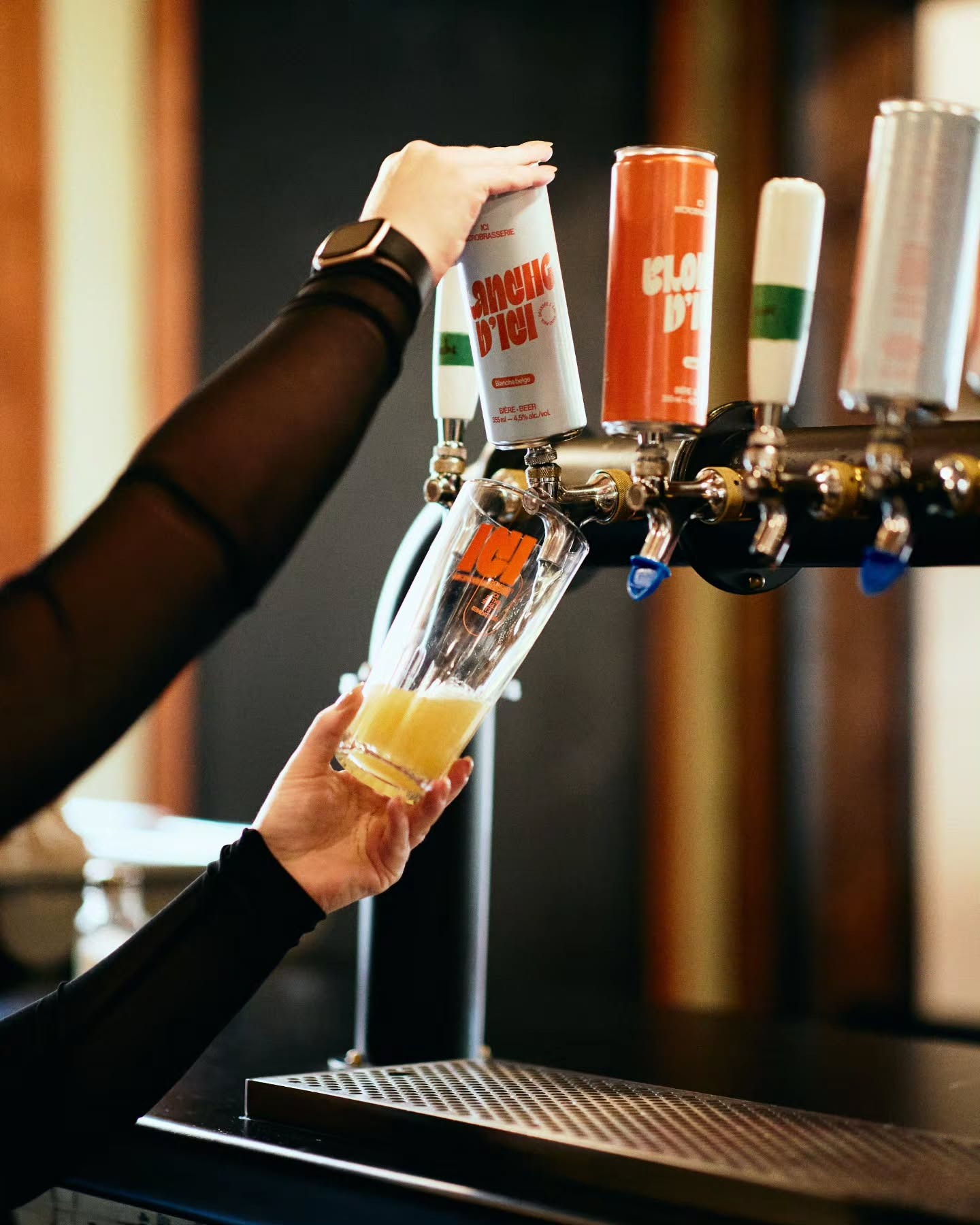
In Baie-Saint-Paul, ICI Microbrasserie represents a new generation of brewery projects that seem to have understood that a business does not necessarily need to become big to become successful.
The project was launched by Alexandre Côté and his business partner Anthony, who are also involved with Hydromel Charlevoix, a company focused on honey, mead, and artisanal spirits. Anthony previously operated a restaurant in the same location on Saint-Jean-Baptiste Street, in the heart of Baie-Saint-Paul.
ICI Microbrasserie therefore emerged from a very practical need: to create a complementary offer around an existing business while giving new life to the space.
Beer became a natural extension of the project.
But from the beginning, the partners made a strategic decision: ICI Microbrasserie would not immediately pursue broad distribution across Quebec.
Its beers are primarily available on site.

That decision may seem counterintuitive in an industry where distribution has traditionally been viewed as an important step toward brewery growth. But it makes sense when viewed through the economic realities facing today’s craft breweries.
Distribution requires much more than simply making beer.
There are packaging costs, logistics, sales, representatives, returns, margins, promotions and inventory management. For a small brewery, every new retail account can generate additional work without necessarily producing enough margin to justify the effort.
ICI has chosen a different model: bring customers to the beer rather than sending the beer to customers.
That distinction is important.
At the brewery, the company controls the environment. The beer remains properly refrigerated, the product can be served in optimal conditions and, most importantly, the beer becomes part of a broader experience.
And that experience is not built around beer alone.

Beer as part of the experience
ICI Microbrasserie is not trying to become a destination exclusively for beer enthusiasts.
Instead, the goal is to create an accessible, colourful and welcoming space where beer works alongside food and the overall experience becomes the product.
The brewery’s beers are relatively light, generally ranging from 3% to 5% ABV, and are designed as easy-drinking, refreshing beers.
The concept is straightforward: beers that are approachable, refreshing and easy to understand, and that can accompany a meal without necessarily becoming the entire focus of the experience.
That philosophy also extends to the food menu.
The team is not trying to create a high-end gastronomic restaurant aimed exclusively at food enthusiasts. Instead, it wants to offer accessible, well-executed dishes that can appeal to a broad audience.
And this may be one of the project’s most interesting lessons.
After several months of operation, Alexandre Côté says food represents a significant part of the business, with customers often talking as much about the kitchen as they do about the beer.
It is a reality that many breweries are discovering: the taproom is no longer simply a place to drink beer. In many markets, it has become a full-fledged hospitality and food business.
Beer may bring customers through the door, but the overall experience determines how long they stay, what they consume, and whether they return.

A brand that goes beyond traditional beer codes
Another element that distinguishes ICI is its visual identity.
In an industry where breweries often attempt to differentiate themselves primarily through beer names and labels, ICI has built a much broader visual universe.
The branding was developed with designers from Quebec City, Jean-Christophe and Laurie, who created a colourful, playful and highly recognizable identity.
The result deliberately moves away from some of the more restrained visual codes often associated with the region’s craft breweries.
ICI wanted something more energetic.
Bold colours, hand-drawn characters, references to foam and an aesthetic that can sometimes feel closer to contemporary cafés, wine bars or modern hospitality concepts give the brewery a distinctive personality.
That consistency extends across the glassware, cans, interior design and terrace.
The choice of a 355 ml sleek can is also part of the strategy.
For light, refreshing beers, the smaller format fits the drinking experience. It keeps the beer cold longer and gives customers the option of having another beer without starting with a large serving.
It is also a visual decision.
The 355 ml sleek can is closer to the codes of modern beverages, ready-to-drink cocktails and contemporary consumer products than those of traditional beer packaging.
In other words, the package itself becomes part of the positioning.

A deliberately small brewery
ICI is also not trying to produce an enormous range of beers.
For now, the core lineup consists of roughly four beers, with additional seasonal or guest releases possible.
That limitation is intentional.
For Côté, too much choice can sometimes complicate the consumer experience. With four beers, customers can easily taste the full lineup and discover the brewery’s range without being overwhelmed.
It is also more realistic for a small production facility.
The brewery operates with relatively modest and flexible equipment. Small batches are produced, while canning is handled through a mobile service.
This may not be the most efficient way to produce beer at industrial scale.
But that is not the objective.
The real question is different:
How do you produce enough beer to meet demand without creating an oversized cost structure?
That philosophy reflects a broader trend emerging in several markets: breweries that are comfortable remaining small, limiting their portfolios, focusing on on-site sales and concentrating on profitability rather than growth at any cost.

Turning locality into a competitive advantage
ICI’s model is also deeply connected to its location.
Baie-Saint-Paul is an important tourism destination in Charlevoix. Visitors already come to the region for its landscapes, restaurants, local products and food-and-beverage businesses.
In that environment, choosing not to distribute the beer everywhere can actually become an advantage rather than a weakness.
If you want to drink this beer, you have to come to Baie-Saint-Paul.
That creates a form of scarcity.
It also allows the team to tell the story behind the beer directly, explain the ingredients and highlight the other local businesses involved in the project.
The concept is built around a simple idea: local products, consumed locally, in a place that is part of the territory.
The team also wants to work increasingly with Quebec-grown raw materials. A significant portion of the malt already comes from InnoMalt, and the company is considering the possibility of sourcing or growing more grain locally in the future.
That fits into another important industry trend: breweries looking to build more regional supply chains and establish closer relationships with farmers and ingredient suppliers.

A lesson for the next generation of breweries
ICI Microbrasserie has only been operating for a short time, but its business model already raises several important questions for entrepreneurs considering entering the craft beer industry.
The first is simple:
Does a brewery really need to distribute its beer?
Increasingly, the answer appears to be no.
The second:
Does a brewery really need 12, 15 or 20 beers in its portfolio?
Again, not necessarily.
And the third:
Does success have to mean becoming a large company?
For ICI, the answer is clearly no.
The objective is to build a business that is efficient enough to be profitable, provide a strong customer experience and, eventually, give its owners a sustainable quality of life.

That may be the most significant shift of all.
For years, brewery success was often measured through growth: more beer, more retail accounts, more tanks, more production.
ICI offers another definition of success:
Less volume, but more control.
Control over the product.
Control over quality.
Control over the customer experience.
Control over the relationship with consumers.
And, perhaps most importantly, control over costs.
In a market where growth is becoming increasingly difficult and expensive, this approach could become much more common.
ICI Microbrasserie may not have ambitions to become Quebec’s next major brewery.
And that is precisely what makes the project interesting.

In an industry that has traditionally celebrated growth, the next generation of craft breweries may instead learn to value precision, proximity and profitability.
In Baie-Saint-Paul, ICI appears to be moving in that direction.
And for a brewery still in its first year, it is a business model worth watching.
51 Rue St Jean Baptiste, Baie-Saint-Paul | instagram.com/icimicrobrasserie

