


Five retail and local-product organizations are trying to turn Quebec’s buy-local momentum into a permanent consumer habit. For food, beverage and beer companies, the bigger question is whether local sourcing can become a competitive advantage rather than simply a response to trade tensions.
“Buy local” has become an increasingly familiar message in Quebec.
The pandemic strengthened it. Trade tensions with the United States gave it another boost. But there is a problem with relying on economic uncertainty to drive consumer behavior: eventually, the crisis moves on.
Now five organizations want to make local purchasing less of a reaction and more of a habit.
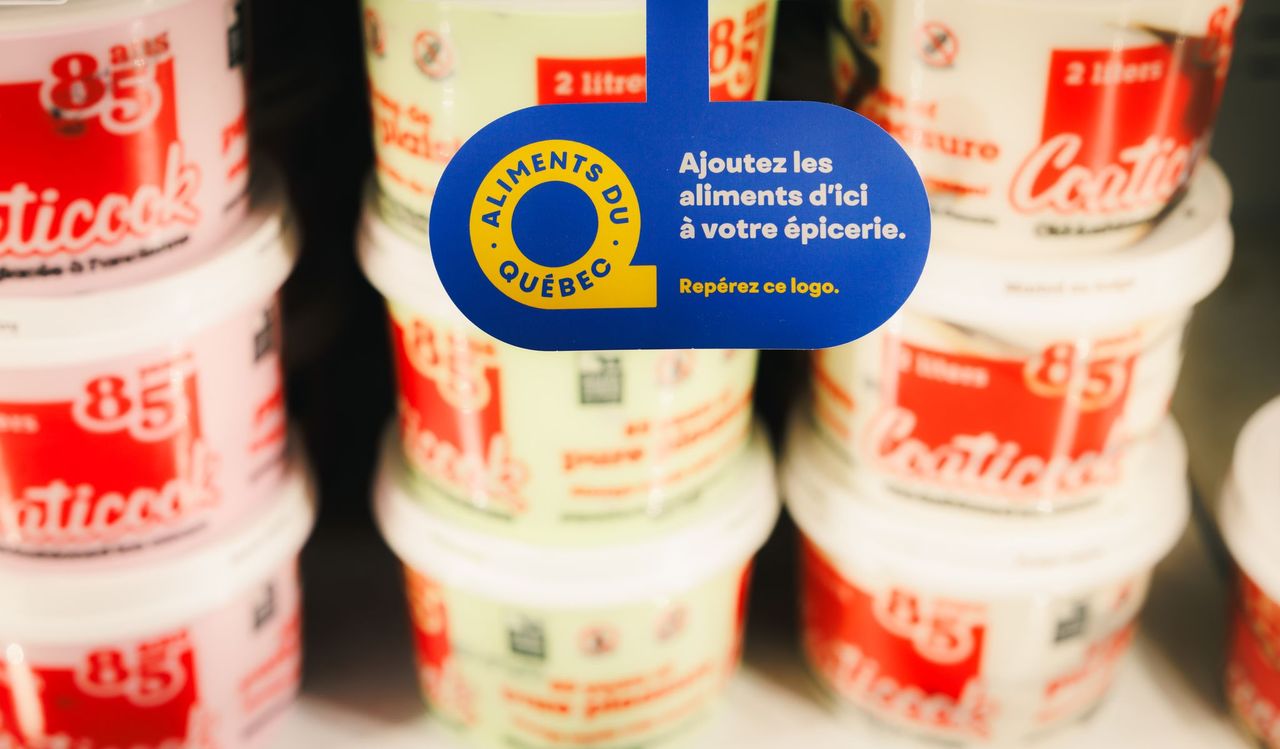
Aliments du Québec, Les Produits du Québec, the Association des détaillants en alimentation du Québec, the Conseil québécois du commerce de détail and the Retail Council of Canada are joining forces to encourage consumers, retailers, manufacturers and producers to make Quebec-made products a more permanent part of the purchasing equation.
Their message is deliberately different from a boycott campaign.
Rather than telling consumers what not to buy, the organizations want to make it easier to identify, find and choose products made, grown, processed or designed in Quebec.
That distinction matters.
The problem isn’t necessarily supply. It’s visibility.
Quebec already has a significant local-product ecosystem.
Aliments du Québec says it verifies the origin of roughly 30,000 Quebec food products. Les Produits du Québec says its certification covers approximately 150,000 products, available through more than 25 retail partners across roughly 20 consumer sectors.
The question for manufacturers and retailers is what happens at the point of purchase.
A local product can exist without being discovered.
In grocery, a shopper has seconds to make a decision. Price, promotion, shelf position, packaging and brand recognition can all outweigh a general intention to support local companies.
Certification therefore becomes more than a logo.
It can function as a piece of retail infrastructure: a shortcut that helps consumers identify origin without having to research every product.
For local brands, that can be valuable real estate.

Local purchasing has to work commercially
There is an obvious limit to the buy-local argument.
Consumers may want to support local producers, but they still have budgets.
Retailers may want to expand local assortments, but they still need products that generate sufficient turns and margins.
Manufacturers may want to source locally, but domestic suppliers have to be able to meet requirements for price, volume, consistency and delivery.
That is why the comments from Quebec retail leaders are particularly important.
The Conseil québécois du commerce de détail is warning that retailers cannot simply be asked to prioritize local products while competing against businesses operating under different cost and regulatory conditions.
In other words: local purchasing cannot be built entirely on consumer goodwill.
The economics have to work.
A $25-a-week proposition
Les Produits du Québec is putting a number behind the economic argument.
The organization says that replacing $25 a week in non-food purchases with Quebec-made products could generate up to C$3 billion in economic benefits.
The number is designed to illustrate the cumulative effect of relatively small purchasing decisions.
For the food and beverage industry, however, the more interesting question is how that money moves through the supply chain.
A local purchase can mean revenue for a Quebec manufacturer, business for a local distributor, work for a regional logistics company and sales for a retailer.
The economic value does not necessarily stop with the product itself.
That is increasingly relevant as companies reconsider supply-chain exposure after several years of pandemic disruption, transportation problems, tariffs and geopolitical uncertainty.

Resilience isn’t free
There is a tendency to describe local sourcing as an uncomplicated solution to supply-chain risk.
It isn’t.
Quebec producers can face higher labor, packaging, ingredient and transportation costs than international competitors. Smaller manufacturers may not have the scale to match multinational suppliers. Retailers may have limited shelf space and increasingly sophisticated margin requirements.
Building resilience therefore involves trade-offs.
A shorter supply chain can provide greater visibility and potentially greater flexibility, but it does not automatically provide lower costs.
For beverage companies, that calculation is particularly familiar.
A local brewery may have an obvious geographic advantage, but it still has to compete for shelf space, draft lines, distributor attention and consumer spending.
The “local” story can open the door.
It cannot replace execution.
Beer is already part of the experiment
The Quebec brewing industry has spent years navigating this exact tension.
Consumers regularly express support for independent breweries and local beer. But the beer still has to be priced competitively, distributed efficiently and available where people shop.
A brewery can have a strong local identity and still lose a sale if its beer is unavailable, poorly positioned or significantly more expensive than the alternative.
That makes the new push particularly relevant to beverage producers.
Certification and local-product programs can help create a common language between producer and retailer. But they work best when paired with the fundamentals of retail: availability, visibility, pricing and rotation.
From political moment to purchasing habit
The biggest challenge for the five organizations may not be awareness.
Quebec consumers already know what “buy local” means.
The challenge is retention.
The local-buying movement has benefited from several extraordinary moments: COVID-19, supply-chain disruption and Canada-U.S. trade tensions.
But if local purchasing falls back as soon as those pressures ease, it remains a temporary behavior rather than a structural shift.
The goal now is to make local products easier to recognize and easier to buy regardless of the political or economic news cycle.
That means placing certification where consumers can see it. It means retailers giving local products meaningful visibility. And it means manufacturers making the business case to buyers, not simply the emotional case to consumers.

The bigger opportunity is industrial
For the beverage industry, this conversation should ultimately move beyond flags, logos and patriotic messaging.
The more consequential question is whether Quebec can build stronger commercial relationships between producers, manufacturers, distributors and retailers.
That could mean more regional sourcing.
More domestic manufacturing.
More resilient distribution networks.
And potentially more value retained within the province.
But achieving that requires a realistic understanding of the economics.
Consumers cannot be expected to absorb every additional cost simply because a product is local. Retailers cannot sacrifice margins indefinitely. Manufacturers cannot build sustainable businesses on goodwill alone.
The local product has to earn its place.
That is what makes the September 8 initiative more interesting than another buy-local campaign.
It is an attempt to move the conversation from “What should consumers avoid?” to “How do we build a market where local products are competitive enough to become the natural choice?”
If Quebec succeeds, local purchasing could become something more durable than a response to tariffs or trade disputes.
It could become part of the province’s commercial infrastructure.
And for food and beverage companies, that may be the more important opportunity: not simply selling local, but building a supply chain that makes local commercially viable.

