


Presented by PivoHub and Étiquette PDF.
What does it take to launch a functional beverage today?
That was one of the questions we explored on Beverage + Terroir, recorded at CHFA NOW Toronto, where the conversation quickly moved beyond the drink itself and into the business of building a beverage company from the ground up.
We sat down with Simrit (Simmy) Sidhu, founder of Drastic Drink, a Canadian supplemented hydration and recovery beverage based in Oakville, Ontario. Her story is still in its early stages: a first production run of 15,000 bottles, two SKUs, a newly launched website, and the beginning of conversations with retailers.
But there is already a surprisingly complete business strategy behind those first bottles.
Drastic Drinks was initially conceived as a hangover beverage while Simrit (Simmy) Sidhu was finishing school. The idea then evolved as consumer expectations changed. Rather than focusing on one specific occasion, the brand moved toward a broader proposition around hydration and recovery — whether after exercise, while travelling, following a night out or simply as a functional drink during the day.
That evolution is important because it illustrates one of the central challenges facing emerging beverage brands: a product may begin with a very specific use case, but the business needs enough occasions to create repeat consumption.
From idea to first production run
Drastic Drinks has already made one of the biggest jumps for a new beverage company: moving from formulation to commercial production.
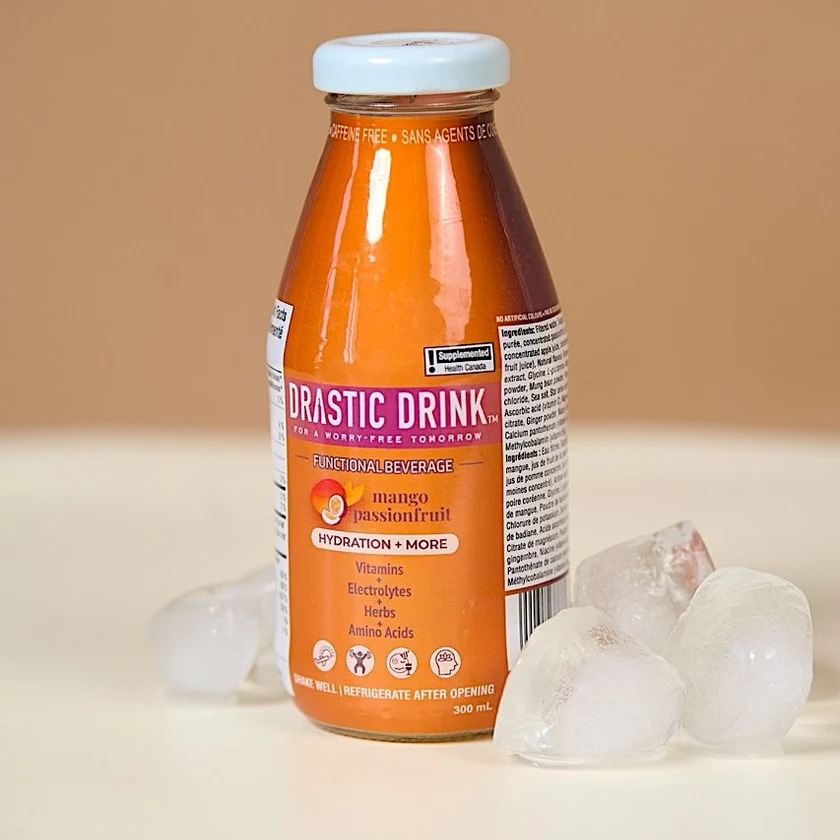
The company recently completed its first production run of 15,000 bottles, using a co-packer. Rather than launching in cans or conventional plastic packaging, the brand chose glass.
That decision is more than a packaging choice.
For a new beverage trying to get noticed, packaging becomes part of the positioning. Simrit (Simmy) Sidhu describes the glass bottle as a way to create a more premium experience, differentiate the product on the shelf, and reinforce the brand’s sustainability message. She also sees the material as contributing to the drinking experience.
This creates an interesting business equation.
Glass can help a beverage stand apart, but it also introduces additional weight, transportation considerations and packaging costs. For an emerging brand, those costs matter. Every decision that makes a product more premium also has to be supported by a price consumers will accept and a margin that allows the company to grow.
Drastic Drinks is therefore entering the market with a deliberate premium proposition rather than trying to compete primarily on price.
The brand currently has two flavours: Mango Passion Fruit and Raspberry Hibiscus. The objective is to cover different taste preferences, with one positioned around a sweeter profile and the other offering a more tart, floral character.
For a young beverage company, two SKUs can also be a strategic advantage.
Launching with a limited portfolio keeps production, inventory, and sales conversations relatively simple. It allows the founder to learn which flavour performs, where consumers respond, and what retailers want before adding additional complexity.
In other words, the next SKU should not necessarily be driven by the founder’s desire to launch something new. It should be driven by market information.
Simrit (Simmy) Sidhu says that is precisely how she is approaching future flavours: first establish the current products and listen to consumers.

The science behind the product
Another defining element of Drastic Drinks is the amount of research behind the formulation.
Simrit (Simmy) Sidhu has a background in biomedical engineering, including both bachelor’s and master’s degrees, and says she spent several years researching the formulation. She also spent approximately a year specifically working on flavour development. Before formulating the drink, she surveyed 500 buyers about dehydration symptoms and flavour preferences.
That research-first approach reflects a broader shift in functional beverages.
The category is increasingly crowded with products making claims around hydration, energy, recovery, wellness and performance. In that environment, simply adding a long list of functional ingredients is unlikely to be enough. Brands have to explain why those ingredients are there, what role they play and why the consumer should care.
Drastic Drinks contains vitamins, electrolytes, herbs and amino acids. The company also emphasizes its ingredient list, including the use of monk fruit as a sweetener and the absence of preservatives and artificial flavours.
That gives the brand another potential advantage: the founder can explain the product story in detail.
For an emerging brand, that matters. A retailer may not have the time or resources to explain a complicated formulation. The clearer the story, the easier it becomes for a salesperson, buyer or consumer to understand what makes the product different.
Premium ingredients meet premium packaging
But there is an obvious tension here.
Glass is more premium. The formulation includes multiple functional ingredients. Fruit purées are used in the flavours. Research has been invested in formulation and flavour. A co-packer is involved in production.
All of these elements contribute to cost.
At the same time, the company is entering a market where consumers have plenty of alternatives.
This is where beverage strategy becomes less about the recipe and more about unit economics.
A founder has to understand the cost of ingredients, packaging, production, transportation, warehousing, retailer margins and marketing before determining whether the final price can support the business.
Drastic Drinks is effectively choosing to compete through differentiation rather than trying to become the cheapest hydration beverage on the shelf.
That means the premium has to be visible and understandable.
The bottle needs to communicate quality. The formulation needs to communicate function. The flavour needs to deliver on the promise. And the business needs enough margin to continue producing.
The co-packer relationship
Perhaps one of the most revealing parts of the conversation is the discussion around co-packing.
For many emerging beverage brands, the co-packer is effectively part of the manufacturing infrastructure. The founder may own the brand, formulation, and customer relationship, but the co-packer controls a critical part of the physical production process.
Simrit (Simmy) Sidhu approach is to establish that relationship early.
She says she has developed a strong relationship with her co-packer and also works with a food consultant connected to the manufacturing operation who has become a mentor. That relationship began before the product was even on the market.
For a startup, this can be as important as the formulation itself.
A beverage can have an excellent recipe, but if production is inconsistent, minimum order quantities are unmanageable, timelines are unreliable, or communication breaks down, the brand will struggle to scale.
The co-packer therefore becomes more than a production service. It can become part of the company’s operational knowledge base.

The next challenge: getting onto shelves
Drastic Drinks has launched online, but the next phase is retail.
The company is initially targeting independent health retailers, while also beginning conversations with larger retailers as the business develops. Vendor applications have already started.
This is where the CHFA setting becomes particularly relevant.
CHFA NOW Toronto brings together brands, retailers, buyers and industry professionals looking for new products and opportunities. The 2026 event runs from September 25 to 27 at Exhibition Place, with the trade show taking place September 26 and 27. (CHFA)
For a company at Drastic Drinks’ stage, a trade show is not simply about selling bottles.
It is about validating the proposition.
Are buyers interested? Which questions do they ask? Does the packaging stop them? Which flavour gets sampled first? Do retailers understand the functional proposition? Are distributors interested? What price points create resistance?
Those conversations can provide information that no formulation session can produce.

From beverage to business
The most interesting element of the Drastic Drinks story is that the company is still early enough for almost every decision to matter.
The first 15,000 bottles are not simply inventory. They are a test of the entire business model.
The two SKUs are a test of consumer preference. The glass bottle is a test of premium positioning. The formulation is a test of whether research can translate into consumer value. The co-packer relationship is a test of operational execution. And CHFA is a test of whether the brand can move from direct-to-consumer sales into retail.
That makes this conversation useful well beyond the hydration category.
Launching a beverage has never been only about creating a good drink. It is about connecting formulation, packaging, manufacturing, pricing, distribution, and retail strategy into one coherent business.
For Drastic Drinks, that process is now beginning in earnest.
As Simrit (Simmy) Sidhu prepares to take those first 15,000 bottles to market, the next chapter will be less about creating the product—and more about proving the business around it can scale.
🎙️ Listen to the full conversation with Simrit (Simmy) Sidhu of Drastic Drinks on Beverage + Terroir.

